

The 120-Day BFCM Playbook: How E-Commerce Brands Can Win Q4
Nearly 25% of all annual e-commerce GMV occurs in November and December alone. The stakes for Black Friday and Cyber Monday are high, and the brands that consistently win this period start building momentum in August.
Treating BFCM like a sprint is where most e-commerce brands go wrong. If you’re finalizing offers in October and spending early November approving creatives, platform algorithms are already working against you. The difference between a good BFCM and a record-breaking one is almost always decided before the ads go live.
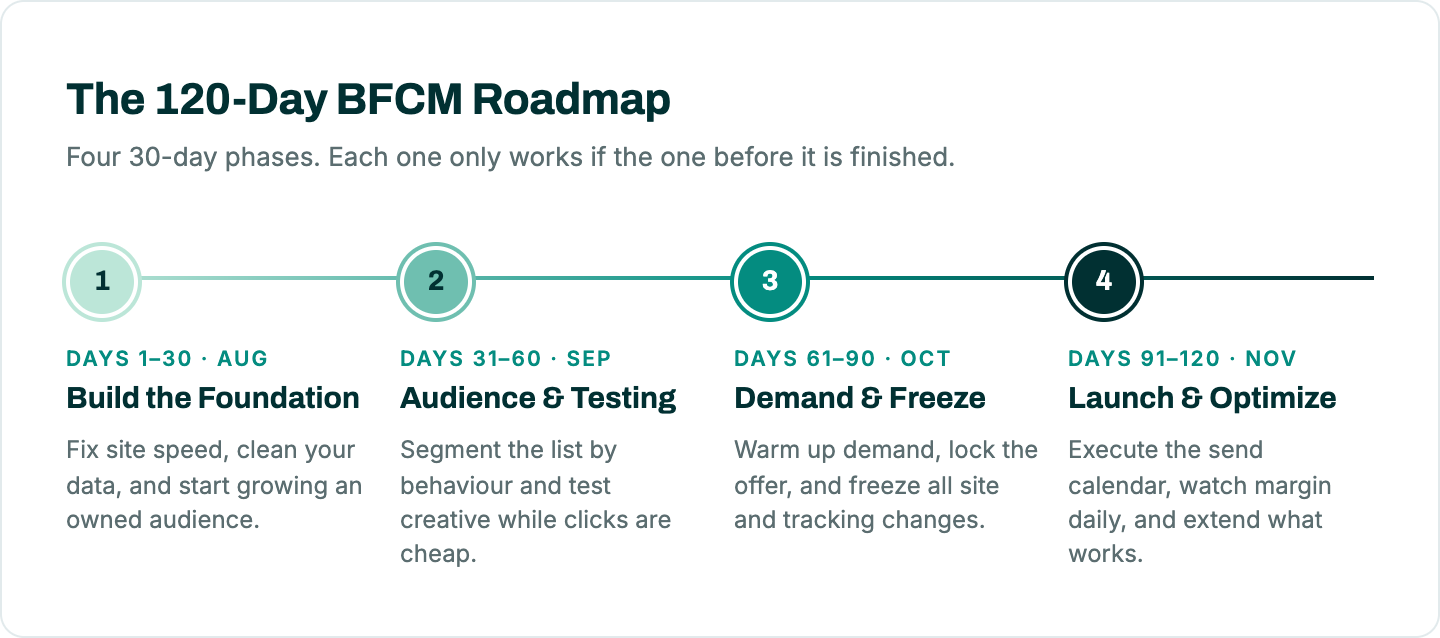
Starting early is the key to maximizing the payoff in November. This playbook maps out the 120 days leading up to launch: what to do, when to do it, and why timing matters as much as the tactics themselves.
Why Q4 Winners Are Made in August
The instinct to wait until Q4 is understandable. BFCM feels like a Q4 priority, but the foundational elements that drive results happen much earlier. Success relies on the audience signals you accumulate, the creatives you validate, the email list you build, and the campaigns you optimize while testing is still cost-effective.
Ad competition in November and December drives seasonal CPM increases of as much as 66% during the holiday shopping period. Brands that wait until November to build audiences pay peak prices for basic acquisition work. Conversely, brands that execute foundational campaigns in August and September pay a fraction of the cost and enter November with warmer audiences, better data, and creatives that have already been proven in the market.
When we worked with MEC on their BFCM campaign, preparation began months in advance. By extending the pre-BFCM period ahead of competitors and grounding the media plan in audience data collected throughout the year, the campaign delivered a 125% increase in impressions, a 76% increase in clicks, and a 13% increase in paid booked revenue year over year.
Days 1 to 30 (August): Build the Foundation
August is when ad costs remain relatively low and decisions can be made without time pressure.
Audit Last Year’s Performance
Before building anything new, understand what actually worked. Pull your BFCM data from the previous year and examine it by channel, by audience segment, and by creative format. What was your highest-converting campaign type? Which audience segments drove the strongest revenue? Where did your budget go that didn't perform?
If this is your first BFCM, look at your strongest sales period from the past 12 months and use that as a benchmark. The goal is to enter planning with evidence, not assumptions.
Start Growing Your Owned Audience
Email and SMS channels are by far the highest traffic drivers, accounting for 43% of all GMV on Black Friday 2024 — an increase from the peak-period average of 38.5%. Across the entire BFCM season, CRM channels were responsible for more than one in three dollars in total ecommerce revenue. Owned channels are the highest-ROI surface available during BFCM, but they take months to build properly.
August is when you should be actively growing your email and SMS lists: testing pop-up forms, refining your lead magnet offer, and segmenting new subscribers by behaviour from the moment they opt in. Subscribers acquired in August and September represent your warmest audience by November, having interacted with your brand well before seeing a holiday promotion.
Plan Your Offer Architecture
Applying a blanket discount across an entire catalog is rarely optimal. Klaviyo's BFCM 2025 data found that brands offering the smallest discounts also saw some of the healthiest sales growth. Rather than aggressive markdowns, their sales performance was driven by personalization, lifecycle timing, and AI-powered recommendations.
Instead of racing to the bottom on price, focus on relevance: the right offer, surfaced to the right segment, at the right moment. Map your offer structure by customer tier in August:
- What exclusive value do VIP customers receive compared to new visitors?
- What specific incentives apply to high-margin product lines?
Days 31 to 60 (September): Build Your Audiences and Test Creatives
September is when preparation becomes operational. After growing your list and mapping your offer architecture is mapped, it is time to build the audiences and creative assets that will carry you through November.
Warm Up Your Paid Media Accounts
Algorithms need data to perform. A campaign launched cold in November, with no purchase history, no audience signals, and no creative learning, is at a significant disadvantage compared to one that has been running and optimizing since September.
Use this month to run mid-funnel awareness and engagement campaigns at modest budgets. The goal is not conversions, but signal accumulation. You are teaching ad platforms what high-intent buyers look like before scaling budgets.
Run Creative Tests
Creative testing during BFCM is expensive and slow. CPMs are at their peak, audiences are saturated with offers, and the feedback loop between impression and conversion is compressed. The brands that arrive at BFCM with proven creative formats, messaging angles, and visual treatments that have already demonstrated performance are at a significant advantage over those still iterating during the event itself.
In September, test at least three to four distinct creative directions across your key platforms. Identify your top-performing product visuals and offer frameworks so that November spend goes toward proven assets.
Segment Your Email List by Behaviour
During BFCM 2025, Klaviyo delivered 22.7 billion messages (a 25% year-over-year increase) generating more than $3.8 billion in attributed revenue. Brands leaning into precision targeting and lifecycle timing consistently outperformed those that blasted broadly.
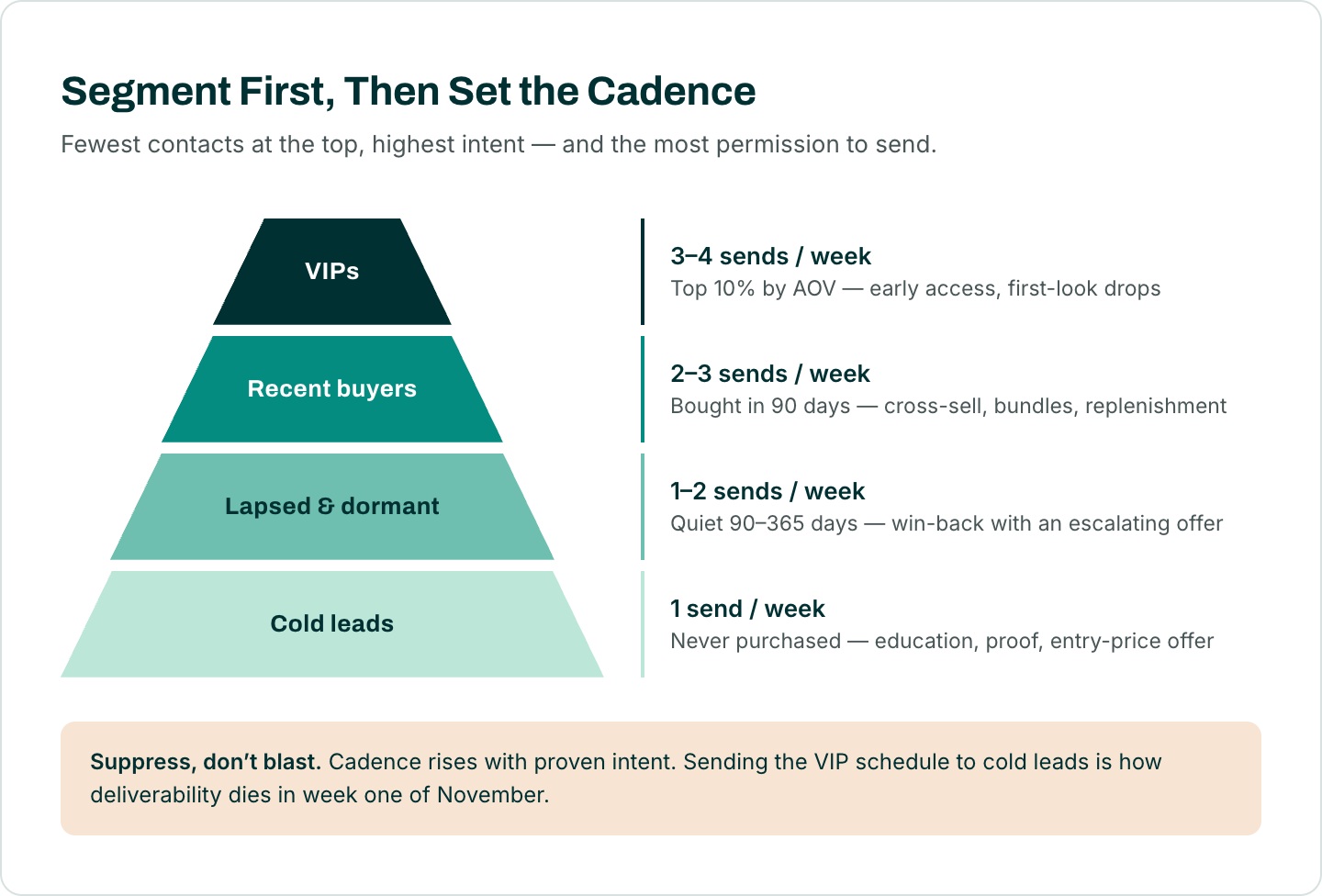
September is the time to build your segmentation architecture. Separate active subscribers from lapsed ones, identify your highest-value customers by purchase history and AOV, and begin tailoring content to each group. Your VIP segment should be receiving content that makes them feel like insiders well before your BFCM offer lands in their inbox.
Days 61 to 90 (October): Activate Demand and Extend the Window
Rewarding loyal buyers with early access pulls demand forward into a less competitive ad environment. Revenue growth from repeat shoppers in 2025 outpaced new buyer acquisition growth by 45%.
Additionally, data from Tapcart confirmed that BFCM is now effectively a full month, with 6 in 10 shoppers already starting to shop online in October or early November. 35% of consumers want to hear from brands as early as October 29, a full month before Black Friday. If your brand isn’t visible by then, you’re missing out on a meaningful share of shoppers.
Build High-Intent Retargeting Pools
Site visitors browsing products or abandoning carts in October represent prime retargeting prospects for November. Build retargeting audiences categorized by intent depth: product viewers, cart abandoners, and repeat site visitors.
Finalize Campaigns and Freeze Technical Changes
Industry best practice is to freeze all technical changes to your site and campaigns two weeks before BFCM. That means your landing pages, checkout flow, discount codes, and pixel tracking should all be finalized and tested by mid-October at the latest. A broken discount code or a slow-loading mobile checkout page on Black Friday can lead to permanent lost revenue.
Days 91 to 120 (November: Execute and Optimize)
Execution replaces planning in November. The primary goal is dynamically managing campaigns to capture demand.
Launch Early Promotions
Last year, a record 203 million consumers shopped over the 5-day Thanksgiving weekend. However, many shoppers research purchases well before buying.
Launching promotions in early November engages buyers during their consideration phase. This was central to the strategy we executed with MEC. By building a media plan that extended the pre-Black Friday period ahead of competitors, we were able to drive a 65% increase in new paid users and a 58% increase in paid traffic sessions year over year, reaching shoppers before ad clutter peaked.
Optimize for Mobile Commerce
Over 70% of all online BFCM purchases in 2025 were made on mobile devices. If your mobile checkout experience is slow, complicated, or visually misaligned with your ads, you are losing conversions at the final step regardless of how well everything else is performing.
Test your mobile checkout flow end-to-end in October. Pay particular attention to page load speed, the number of steps between cart and confirmation, and the coherence between your ad creative and your landing page experience. A shopper who clicks a BFCM ad on their phone and lands on a page that takes four seconds to load will leave before they see your offer.
Allocate Budget Dynamically
Top performers scale budgets significantly during BFCM week, but allocation should remain fluid. Black Friday and Cyber Monday are peak conversion days; the days between them often see softer returns.
Monitor ROAS in real time and be prepared to shift budget toward the placements and audiences that are converting, rather than holding to a pre-planned allocation that may not reflect live conditions. We recommend retaining a reserve for Cyber Monday morning, when undecided shoppers make final buying decisions.
Align Paid and Owned Channels
It is easy to let email become an afterthought when paid media budgets are scaling and real-time optimization demands attention. However, owned channels are where margin is made during BFCM.
SMS text message revenue grew 25% year over year during the 2025 peak season. Ensure your email and SMS campaigns match your active paid ad creatives, landing pages, and promotional messaging, rather than running as a parallel track that competes for attention. Our full-service media team can partner with your brand to scale paid media and owned channels in sync.
Post-BFCM: Turn One-Time Buyers into Repeat Customers
BFCM weekend gets the most attention, but the post-BFCM window is where retention is won or lost. The customers you acquired over Black Friday weekend are at their highest engagement point with your brand.
Implement post-purchase automation flows that extend beyond shipping confirmations. Recommend complementary items, offer loyalty points, and invite new buyers into your VIP community to maximize lifetime value (LTV).
What We Learned from MEC
Working with Mountain Equipment Company across a full year of paid media campaigns, from spring camping season through to BFCM, reinforced several principles for Q4 success.
- Preparation compounds: Audience data and creative learnings gathered from earlier promotions create a stronger foundation for BFCM.
- Early market entry lowers acquisition costs: Entering the market ahead of competitors builds warm audiences at lower CPMs.
- Omnichannel alignment drives efficiency: Paid media, search, and owned channels deliver stronger return on ad spend when executing a unified message.
Frequently Asked Questions (FAQ)
How much should I discount during BFCM?
Previous data found that discount ranges of 10 to 15% and 20 to 25% outperformed steeper price cuts, with consumers prioritizing product quality and brand relevance over the deepest available deal. Blanket storewide discounts are often less effective than targeted, relevant offers surfaced to the right segment at the right time.
Which channels drive the most BFCM revenue?
Owned channels (email and SMS) consistently deliver the strongest returns on a margin-adjusted basis, since there is no CPM cost. Among paid channels, Google Shopping captures high-intent buyers actively searching for products, while Meta drives volume through retargeting and broad audience reach. The optimal mix depends on your audience, your product category, and how well your owned list has been built ahead of the event. Our paid advertising experts can help curate a targeted blend to best reach your brand’s prospects.
How do I avoid overspending on paid media during BFCM?
Set clear budget guardrails by day and by campaign type before the event begins, and hold a reserve for Cyber Monday. Monitor performance in real time and shift budget toward what is working rather than holding a fixed allocation. Most importantly, do the audience-building work in advance.
About the Author

Michael is Rely Digital's Growth & Analytics Lead, overseeing paid media strategy and execution across a diverse portfolio of clients. His work spans managing over $6 million in annual ad spend across paid search, display, video, social and emerging channels. Michael specializes in building attribution models and paid advertising infrastructure, particularly for ecommerce clients navigating the complexity of multi-platform tracking. His work has been recognized at the 2024 Google Search Honours Awards, where he led Rely Digital's winning submission for Performance Marketing Excellence.

.png)


