
Effective Demand Generation Funnels for Modern B2B Buyers
At any given moment, roughly 95% of your potential customer base is not actively looking to buy. They are not researching solutions, comparing vendors, or evaluating pricing. Instead, they are going about their day-to-day operations, either unaware they have a problem or aware of it but not ready to solve it yet.
Most B2B marketing budgets focus exclusively on the other 5%, or the slice of the market actively in buying mode. It's easy to measure and conversions tend to happen quicker. However, this approach is also highly unsustainable.
The brands prioritizing consistent, long-term growth utilize demand generation funnels. Unlike traditional sales funnels that push for immediate contact, demand generation funnels pull prospects in through ungated content and thought leadership. They’re designed to build brand authority and ultimately be top-of-mind by the time someone decides they need a solution.
Whenever the 95% eventually enters buying mode, they will already have spent time forming opinions about your brand, your competitors and the category itself. Becoming their default choice is the result of remaining present and credible throughout that journey.
What Is A Demand Generation Funnel?
A demand generation funnel is an end-to-end strategic framework designed to create brand awareness, establish market authority, and build strong affinity across your entire addressable market.
While traditional sales funnels rely on high-friction tactics (such as aggressive CTAs and gated resources) to force immediate contact, a demand generation funnel focuses on long-term value creation. The former might work for the 5% already in buying mode, but demand generation funnels are designed to pull people in. By offering genuine value with no expectation of instant conversion, they build trust and familiarity over time. This ensures that when an out-of-market prospect eventually enters an active buying cycle, your company is naturally at the top of their list.
Demand Generation vs Lead Generation
While these terms are often used interchangeably, they represent two distinct pillars of a complete marketing program. The key difference: demand generation creates and expands market interest, whereas lead generation converts existing interest into direct contacts.
Both frameworks are essential for a well-balanced sales pipeline. Creating market demand without a capture mechanism wastes potential revenue, while running lead generation without prior brand building yields low-quality contacts. Businesses aiming to convert captured interest into booked meetings can pair their brand strategy with specialized lead generation and inquiry funnels.
How Have Demand Generation Funnels Changed?
The way B2B buyers research and decide has fundamentally shifted in the past three years, and most marketing teams have not caught up to it.
Modern enterprise decision-makers no longer follow a neat, linear path from awareness to decision. In fact, 75% of B2B buyers prefer a rep-free sales experience, choosing to conduct independent research online rather than relying on vendor presentations. Today's decision-makers evaluate options continuously across podcasts, social platforms, industry networks, and AI search engines. They jump fluidly between problem identification, solution comparison, and vendor validation.
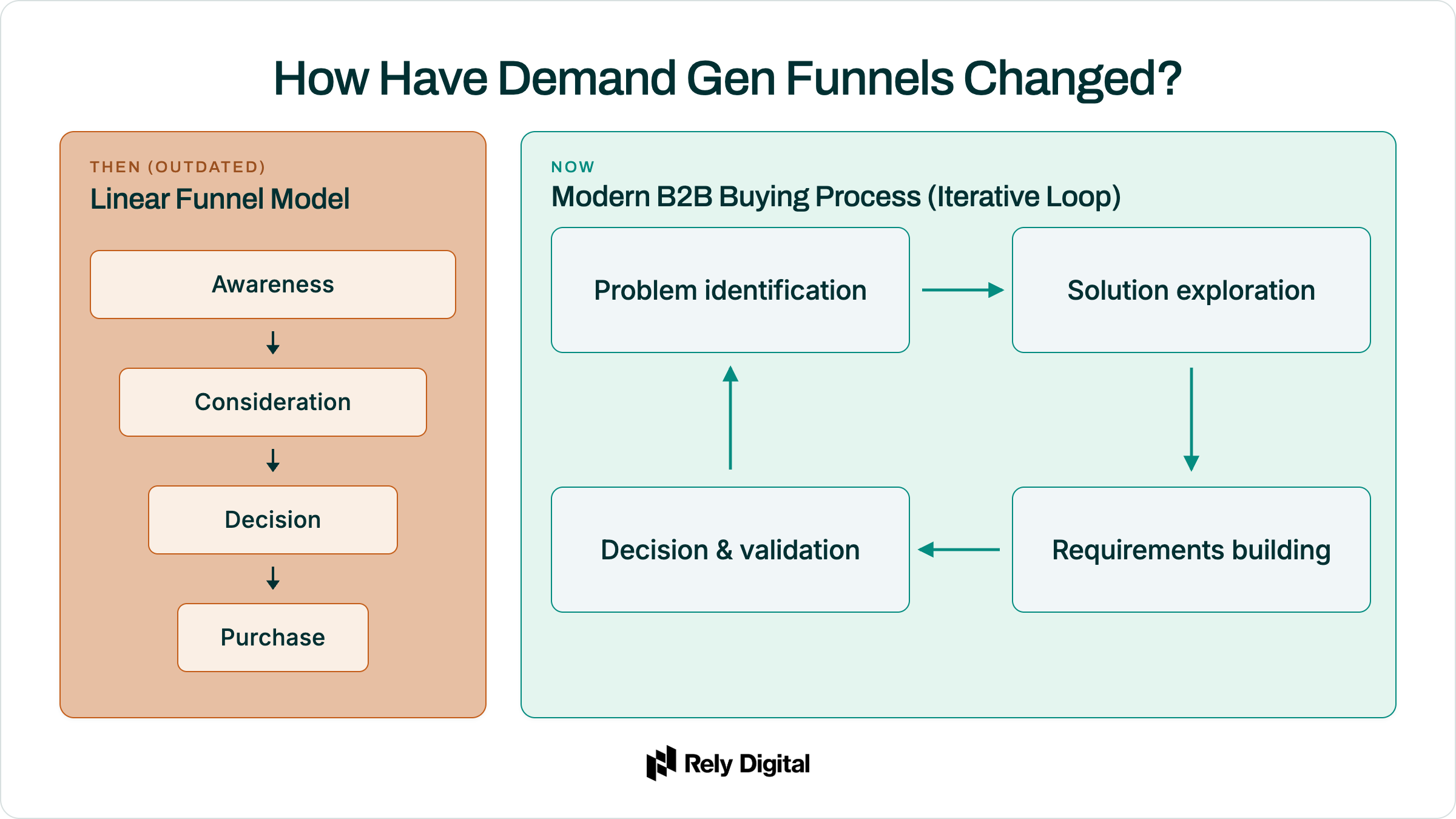
Because buyers complete most of their evaluation before contacting sales, your content must be freely accessible everywhere they look. Structuring your presence for modern discoverability through Answer Engine Optimization (AEO) ensures your brand remains visible when prospects conduct self-guided research.
This is why traditional lead generation funnels have become less effective for top-of-funnel awareness. Prospects no longer want to trade their email for a guide. They want to read it on your website, share it with their buying committee, and decide for themselves if your company is worth getting in touch with.
Building an Effective Demand Generation Funnel in 2026
Building a modern demand generation engine requires rethinking how you structure content, allocate budget, and align your team around buyer behavior rather than sales process.
Define & Validate Your Ideal Customer Profile (ICP)
Effective demand generation starts with absolute certainty of who you are speaking to. A well-defined Ideal Customer Profile (ICP) goes beyond basic company size or job titles. It should outline:
- Firmographics and Technographics: Account sizes, tech stacks, revenue ranges, industries, and geographic focus.
- Core Pain Points: Specific operational roadblocks your product or service eliminates.
- Buying Committee Dynamics: The exact roles involved in the purchase decision, from end-users to financial sign-offs
- Timing and Triggers: What events typically push prospects from unaware to actively looking (budget cycles, new hiring, system failures)
Focusing on a tight ICP prevents wasted ad spend and allows you to build deeply resonant messaging.
Shift to Ungated Content
Demanding contact information for every blog post, guide, or teardown creates friction and limits your reach. Modern demand generation relies on distributing valuable insights freely.
This is counterintuitive for teams accustomed to lead capture, but the math is simple: one gated ebook that 100 people download is less valuable than an ungated guide that 10,000 people read. The ungated version builds brand awareness, establishes thought leadership, and creates mental availability that pays off when prospects enter buying mode.
Publish openly: industry analyses, product teardowns, case studies, actionable frameworks, and podcast interviews without landing page gates. Maximize distribution by repurposing core insights into social posts, short videos, and newsletter highlights so prospects encounter your ideas on their preferred platforms.
When buyers access valuable insights without sales pressure, brand affinity grows naturally.
Build and Maintain a Cohesive Brand & Creative System
Design and messaging shape perception long before a prospect reads a word. In competitive markets, clear, consistent branding can help dramatically accelerate decision-making.
- Align visual identity across ad creative, landing pages, and pitch decks
- Replace generic stock images with custom data visualizations and branded assets
- Maintain consistent tone and visual treatment across all touchpoints to build instant brand recognition
Investing in a clear brand and creative strategy reduces the cognitive load on prospects: they recognize your brand, they know what you stand for, and they trust the consistency. It also gives your sales team ammunition. A prospect who has seen your creative across multiple channels for months arrives at a sales call already warmed up and familiar with your positioning.
Align Sales and Marketing Through Account-Based Strategies
Demand generation works best when sales and marketing operate as a single revenue team with aligned incentives and shared data.
Instead of passing generic leads to sales based on minor content downloads, monitor and prioritize real intent signals: repeat website visits, pricing page views, product demo requests, high-intent keyword searches, and engagement with your highest-value content. Use these signals to score which accounts should receive direct outreach versus nurture campaigns.
Account-based marketing (ABM) flips the traditional funnel on its head. Rather than generating many leads and hoping some convert, you identify your best-fit accounts, coordinate marketing and sales efforts to reach them, and build custom campaigns designed to move a specific set of high-value accounts through the pipeline. It requires closer collaboration between teams, but it dramatically improves conversion rates and shortens sales cycles.
Pair Demand Creation with Intent Capture
The strongest demand generation programs run two parallel tracks: one building category demand among the 95%, and one capturing active search intent among the 5%.
- Demand Creation: Run targeted social media campaigns, video content, and brand awareness campaigns aimed at your target accounts. The goal is to highlight key problems and position your brand as an authority on solutions. These campaigns run continuously to build mind share over months.
- Demand Capture: Run high-intent paid search campaigns and retargeting ads targeting people actively searching for solutions. These campaigns activate when someone shows buying signals, such as visiting your pricing page, searching for your competitors, or engaging with specific high-intent content.
Combining demand creation with intent capture ensures consistent coverage across both out-of-market and in-market buyers. Even though they may arrive at your website for different reasons, both leave with a positive impression of your brand. Discover how our integrated digital marketing services connect these channels into a unified revenue model.
Optimize Content for AI Engines and LLMs
As more B2B buyers rely on ChatGPT, Claude, and Google AI Overviews to evaluate solutions, your brand needs to be visible in AI-generated answers and recommendations.
To ensure your brand gets cited by AI systems:
- Format content with direct, clear answers to common industry queries.
- Structure data using clear headers, concise tables, and bulleted lists.
- Build topical authority around your core services so AI platforms cite your brand as an authoritative source.
Implementing dedicated SEO and LLM discoverability strategies keeps your business visible across search engines and AI interfaces alike.
Putting It All Together
Sustainable B2B growth requires balancing multiple priorities:
- Build demand among the 95% through ungated content, thought leadership, and brand building
- Capture intent among the 5% through high-intent paid media and lead generation
- Align sales and marketing around account-based strategies rather than lead volume
- Optimize for both traditional search and AI-powered discovery
- Measure success by pipeline impact, not just lead volume
In 2026, choosing between demand generation and lead generation is no longer an option. The top brands are always running both, balancing long-term brand building with short-term revenue capture.
Frequently Asked Questions (FAQ)
What are the key stages of a successful demand generation funnel?
A successful demand generation funnel operates across four interconnected stages: creation, nurturing, capture, and expansion. In the creation stage, ungated educational content highlights key operational problems for out-of-market prospects. During the nurturing stage, consistent thought leadership builds brand authority and maintains top-of-mind awareness over time. When prospects enter an active buying cycle, the capture stage converts this interest through high-intent channels like paid search and frictionless booking paths. Finally, the expansion stage drives ongoing value delivery, client retention, and account growth after the initial deal closes.
How do I measure the ROI of demand generation campaigns?
Measure demand generation ROI by tracking pipeline velocity, blended Customer Acquisition Cost (CAC), and total revenue influence rather than gated form fills. Growth in branded search volume, shorter sales cycles, and higher win rates demonstrate clear brand preference and financial return across your target market.
What are the best practices for qualifying inbound leads?
Qualify inbound leads by automatically scoring prospects against your Ideal Customer Profile while using background enrichment tools to keep contact forms short. Monitor high-intent signals like pricing page visits to flag ready buyers, and enforce clear marketing and sales SLAs for instant lead handoffs.
About the Author

Kelsey is an experienced digital marketer who specializes in leading the end-to-end execution of paid advertising campaigns for leading B2B and B2C clients throughout North America. As the Growth Marketing Manager of Rely Digital, she directs campaigns spanning search, social, display, video and shopping channels, working directly with founders and in-house teams from the earliest stages of strategic planning through to performance analysis. Her industry background includes the Vancouver Canucks, Best Buy, technology startups and beyond.

.png)


