
What Is A Content Cluster? A Guide to Topical Authority
How do you position your brand to be seen as the leading expert in your field? More often than not, the answer lies in the way the content is organized. Spending hours researching, writing and editing a comprehensive post doesn’t guarantee a significant impact on your search rankings or a spike in your AI citation rates, unless it’s structured well.
Search engines and AI systems work by mapping relationships. They need to understand not just what a single page says, but how it connects to your other content and what it signals about your overall expertise. A standalone piece, no matter how good, doesn't tell a complete story. A network of interconnected content does.
That's where content clusters come in. They transform isolated posts into a coordinated system that proves your brand’s topical authority to both search engines and your human readers.
Content Clusters Explained
A content cluster is an intentional organizational structure that groups related pieces of content around core topics you want to be known for. At the center of each cluster is a pillar page, which covers the main topic at a high level. Surrounding that pillar are cluster pages; pieces that dive deep into specific subtopics, each linking back to the pillar and to each other.
Think of it like a grocery store. The pillar page is the giant sign at the top of each aisle – “Coffee Brewing Methods”, for example. The cluster pages (for example, “Drip coffee”, “French press” and “Cold brew”) are the individual products within each aisle. Someone browsing your site can quickly see that you have expansive coverage of the different ways to brew coffee, and can easily navigate to the exact subtopic they need.
Without this organization, your content becomes a disorganized pile of merchandise – imagine going to the store and finding peanut butter next to broccoli. Similarly, search engines have a difficult time figuring out which pieces belong together, and readers can't tell what you specialize in. Despite putting in the effort to publish a thorough and well-reasoned post, the structure ultimately isn't doing the work for you.
How Content Clusters Improve SEO and AEO
The structural benefit of content clusters is twofold: it helps machines read your expertise, and it helps people navigate it.
For search engines: Content clusters send a clear signal about topical authority. When Google crawls your site and finds five deeply researched pieces all linking back to a single pillar page on "running shoes”, the search engine understands that running shoes is a topic your brand owns. This directly affects how you rank on results pages.
For AI systems: Platforms like ChatGPT and Claude work by triangulating information across multiple sources to build a comprehensive picture of a topic. When your content is organized in clusters, with clear internal linking and topical coherence, you're essentially giving these systems a roadmap. They can quickly see that you have deep coverage of specific subjects, and are more likely to cite your content as a trusted source in generated answers.
For your readers: An optimized site architecture with clear clusters reduces friction. Someone landing on your site looking for information on "the best running shoes for flat feet" can easily see that you have it, find it instantly, and then discover related content they didn't know they needed. This improved user experience reduces bounce rates and increases time spent on site.
The impact on your business compounds: better search rankings mean more organic traffic, and more AI citations mean visibility in the places where potential customers are already looking for answers. Improved user experience also leads to higher conversion rates once visitors do arrive at your site. Content clusters are more than just a technical SEO tactic; they're a strategic framework for building sustainable visibility.
Content Clusters vs Content Pillars: What’s the Difference?
.png)
Your content pillars are the core topics your brand wants to be known for, or the main categories of expertise. For an ecommerce apparel brand, pillars might be "athletic tops," "running shoes," and "winter activewear."
Your content clusters are the actual pieces of content you create within and around each pillar. Under "athletic tops," you might have cluster pages on "tank tops," "base layers," and "compression shirts." Each cluster page exists both as a standalone resource and as part of a larger topical ecosystem.
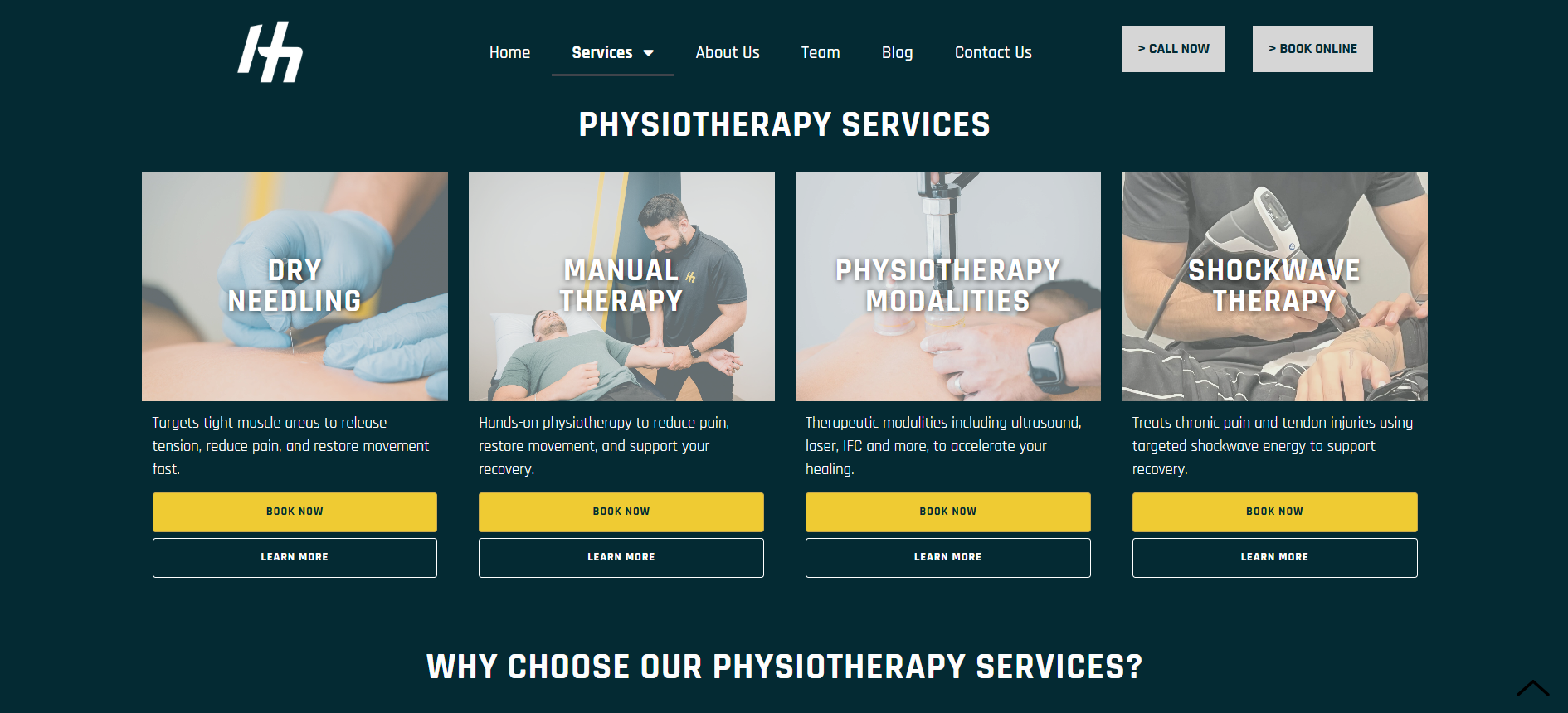
Let’s take a look at one of our clients, Hayer Health. We created several pillar pages for each of their main services. Each pillar page provides an overview of that service, such as what it is and how it works, written for someone in early research mode.
Beneath each pillar is additional cluster content. For example, under the Physiotherapy pillar page, we created focused pieces on dry needling, manual therapy, physiotherapy modalities and shockwave therapy. These cluster pages target a more specific search query and audience.
The site architecture makes the topical authority obvious to both search engines crawling the site and to visitors browsing it. Google understands that physiotherapy is a core area of expertise. AI LLMs recognize Hayer Health as a credible source when someone asks about specific physiotherapy techniques. Visitors get a clear, intuitive navigation experience that builds trust and reduces friction on the path to booking an appointment.
How to Create A Content Cluster: Step-by-Step
Building content clusters is a strategic process. It requires upfront planning to avoid wasting effort on topics that won't drive meaningful impact. Here's how to approach it:
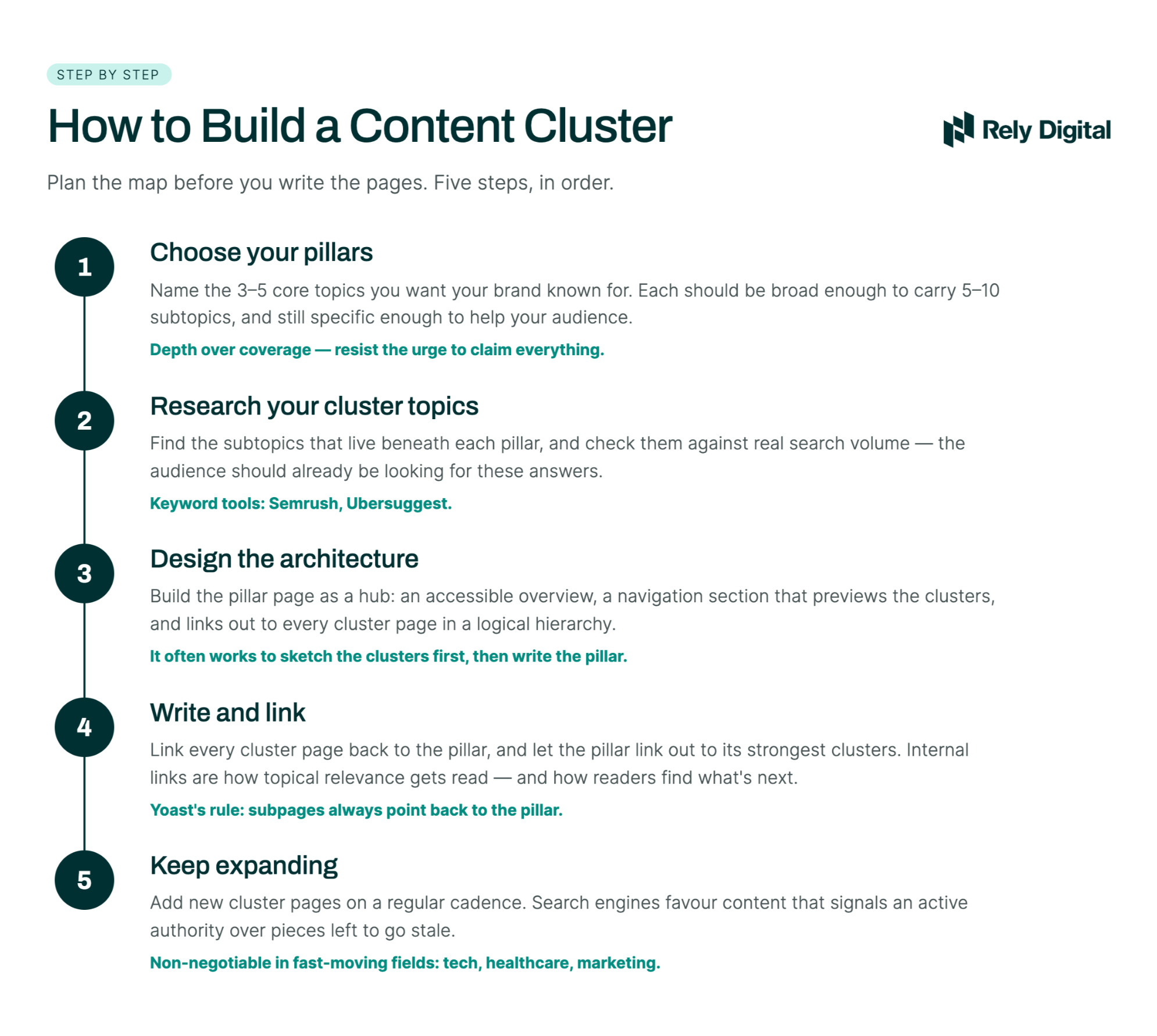
Choose Your Content Pillars
Start by identifying the core topics you want your brand to be known for. It’s important to strike a balance between making sure your pillars are broad enough to develop into 5 to 10 meaningful subtopics, but still targeted to what your target audience would find helpful.
We recommend starting with 3 to 5 pillars and focusing your resources on building intentional authority rather than trying to cover everything remotely related to your business.
Research and Define Your Cluster Topics
Once your pillars are established, the next step is identifying the subtopics that will live beneath each one. The key here is choosing keywords that have a meaningful search volume. In other words, the audience for these topics already exists and is actively searching for answers. Platforms like Semrush and Ubersuggest can help determine the best opportunities for your clusters. Not sure which direction to take your content in? Our SEO and AEO experts can guide you to the right path.
Design Your Pillar Page and Cluster Architecture
The pillar page should rank well enough on its own to capture high-level search traffic, or people who are still researching and aren't yet ready for specifics. However, its real job is to be a hub. When someone lands on the pillar page, they should immediately see that you have in-depth coverage of related topics, and they should be able to click through to the specific content that matches their need.
A strong pillar page typically includes:
- A comprehensive but accessible overview of the main topic
- A clear table of contents or navigation section that previews the cluster content
- Links to each of your cluster pages, arranged in a logical hierarchy
- Visual elements (diagrams, infographics, or sections) that make the page feel like a complete guide
It may also be helpful to do things backwards, i.e. create your pillar page after you have fleshed out a few strong ideas for the appropriate cluster pages.
Write and Link
As you create your content, make an active effort to incorporate internal links. These are simply hyperlinks that direct readers to another page on your website. You could link to other blog pieces that explore a mentioned topic in greater detail, or link to a case study that showcases your past work in a relevant field. This creates a web of topical relevance that search engines use to determine your authority.
Yoast recommends always linking back to the pillar page from all the subpages in the same content cluster and simultaneously using the pillar page to link to the most important pages within the cluster.
Internal links do more than just help search engines. They improve user experience by letting readers discover related content they didn't know they needed. A visitor reading your guide on ACL recovery might discover your page on rehabilitation exercises and realize that's also relevant to them. That's a conversion opportunity you would have missed without strategic linking.
Keep Expanding
Once your content clusters are established, keep adding new pieces on a regular basis. This is especially crucial if you are trying to build authority in an ever-evolving field, such as technology, healthcare or digital marketing. Search engines are known to favour updated content that signals you’re an active authority over out-of-date pieces.
If you’re unsure whether your content is optimally structured, or hitting a roadblock when it comes to knowing what type of content to publish next, our SEO audits can help identify gaps between what you’re currently publishing and active search demand.
Frequently Asked Questions (FAQ)
How do search engines determine website positions?
Search engines use hundreds of ranking factors, but the core principle comes down to relevance, authority, and user experience. Relevance comes from how well your content matches a search query. Authority comes from backlinks, domain age, and topical depth, which is where content clusters help significantly. User experience covers page speed, mobile responsiveness, and how long visitors stay on your site.
What is evergreen content and why is it important?
Evergreen content is material that remains relevant for an extended period after being published, such as “Recovering from an ACL injury” versus “The best running shoes in 2026”. It compounds in value by continuously driving traffic months or years after being uploaded, reduces the pressure to constantly produce new material, and builds long-term domain authority. For content clusters specifically, evergreen content is ideal for your pillar and cluster pages because it establishes lasting topical authority rather than chasing short-term trends.
How do content pillars differ across B2B and B2C companies?
B2B pillar pages typically go deeper into educational and technical content, since a prospect might engage with 15+ pieces before buying enterprise software. B2C pillars are often wider but shallower, as someone buying a t-shirt might only need 2 to 3 pieces of content. B2B clusters focus on building trust and demonstrating expertise. B2C clusters balance education with persuasion, often leading readers toward product pages and purchase decisions. The common denominator is using clusters to organize content in a way that matches how their audience actually researches and buys.
About the Author

Victoria is the Content & PR Coordinator at Rely Digital. Having previously worked in beauty and automotive marketing, she now leads organic content strategy for a diverse client portfolio. She specializes in building content architectures that are optimized for both traditional Google rankings and LLM discoverability, positioning brands for visibility even as the search landscape continues to shift.